Saturday, June 22, 2019

Back in the USSR

I've spent most of the past week immersed in historical television dramas on Soviet themes. Despite their grim subjects, I can't deny the deep nostalgia for Russia that these shows evoked. They reminded me of our universal human capacities for kindness and cruelty, humor and cynicism, acceptance and resistance ... and the specific ways I experienced these capacities in Russia and other places in the former Soviet Union, ever since my first visit in the fall of 1975.


The first program I devoured over these last few days was HBO/Sky's miniseries Chernobyl. I thought that for an American to create a program on the USSR's most serious nuclear accident was nervy -- just imagine all the political and cultural distortions that could result. But I remembered the U.S. television coverage at the time (sample: CBS Evening News) ... surely a carefully constructed drama would be better than those speculative TV news summaries that filled the information vacuum of the time?

I was aware that the HBO/Sky series was getting good marks from a lot of critics, even Russian critics. In Novaya Gazeta, one columnist essentially said "This is the film we should have made." As I weighed the many specific criticisms made by both western and Russian commentators, I appreciated the accompanying five-part podcast in which host Peter Sagal talks with series creator Craig Mazin about his creative choices, and the deviations from the historical record that critics often refer to.

The "voice" of the Sagal/Mazin podcast is typically American -- mostly upbeat, offhand, slangy, sometimes verging on glib. But one thing comes through this conversation constantly: in the series itself, Mazin and his co-workers were determined to show respect to the men and women who risked (and sometimes gave) their lives to save their fellow citizens and potentially a whole continent. They demonstrated that respect by choosing to focus on individuals and stories that exemplified human decency and generosity and the finest aspects of patriotism -- all of which combined to contain the worst possible outcomes of the disaster. Even self-serving bureaucrats occasionally displayed flashes of humanity; the series avoided presenting us with total villains. However, the overwhelming desire of the ruling system to protect itself at all costs, deny problems, and avoid humiliation, was presented with brutal realism -- and (despite some oversimplifications and dramatic exaggerations) rightly so.

"Our goal is the happiness of all humanity."
There were imperfections in the series and podcast accompaniment that aren't explained by the choices imposed by compression and dramatic continuity. For example, in episode four, one of the squads sent out to catch and eliminate abandoned pets is eating and chatting outside a cultural center. A squad member points out a banner attached to the building: "Our goal is the happiness of all humanity." The irony isn't lost on the squad, but even so I wasn't happy that Sagal and Mazin mocked the sentiment. Maybe it's my own exaggerated idealism, but those slogans (however compromised by official corruption and everyday coping mechanisms) reflected real pride among Soviet people. Today those old banners and slogans evoke nostalgia among many Russians who look about in vain for similar ideals in our own time.

Other critics have pointed out historical inaccuracies -- the reactors' deficiencies were not that secret; the authorities were generally no longer threatening executions; the courtroom scenes were practically fictional; the apartment buildings had modern windows, and so on. You can find these complaints for yourself. They don't diminish the main point for me: the enormous wave of heroism among ordinary human beings in the face of a catastrophe that they cannot even understand.

Finally: apart from the riveting plot, a very rewarding aspect of the TV series for me was the attention to visual detail, to the texture of daily life in the mid-1980's USSR. The hospitals I've seen in Russia still look like those in Chernobyl. Same with the older apartment buildings, and with such details as clocks, telephones, stoves, radios, wallpaper, stairwells, and so on. Chernobyl isn't a one-stop substitute for deeper research and reading, but it is a very worthwhile attempt to dramatize history with care and respect for its human dimensions.


The second program was one I'm returning to after almost a dozen years since I first saw it. Here's how I described Shtrafbat after my first binge-watching exposure to the series: (Thanksgiving 2007) ...
I just gave eleven hours of my free time to a fascinating Russian television miniseries, Shtrafbat ("Penal Battalion") on DVD. In WWII Russia, penal battalions were the most expendable of soldiers, made up of criminals and "enemies of the people" who were offered this service as a way to get out of the GULags and redeem themselves by blood from the crimes they'd allegedly committed. The series has some battle scenes, but it's far more devoted to the human relationships among the characters--between regular Red Army and the shtrafniki, between the criminals and the politicals, between the Red Army's military officers and the political officers, between atheists and believers, between wounded soldiers and nurses, and occasionally between Russians and Germans.

Source: IMDB  
In these eleven episodes, there were so many memorable characters and moments of drama. And complete frankness about the NKVD (predecessor to the KGB) and its horrible methods. The battalion commander Tverdokhlebov mentions to his assistant that, when they go into action, the NKVD will station troops behind them to shoot anyone who turns back, even if they're wounded. (It happened.) And the assistant, Glymov, smiles and says, "Ah, how our Soviet leaders so lovingly look after their citizens." Later, after their beloved commander has been arrested by the NKVD on trumped-up charges, the soldiers are standing in formation and the NKVD colonel introduces them to the new commander. One of the soldiers asks, "And what about Tverdokhlebov?" In the confrontation that ensues, the colonel says, "You are enemies of the people. Nothing! Useless!" Glymov waves at the ragged penal battalion troops behind him and says, "These boys still have a bit of usefulness left in them. As for you, your loss wouldn't make a bit of difference."

This could have been a concept ready-made for exploitative violence and sensational gore, or for mindless patriotism and militarism. Instead, the series believably brings to life an almost-forgotten dimension of Russia's wartime experience. At one point, Glymov says that the secret of his survival to that point was not courage, but rather sheer cunning. Nevertheless, we see genuine kindness in his character. I can't help wondering whether, in similar circumstances, I would have been able to preserve as much humanity.
At the time I first saw this series, I wasn't aware of some of the controversy it raised. Some of the controversy I'm inclined to minimize -- for example, I totally disagree with the charge that the series exaggerates the role of penal battalions in the USSR's victory over Germany, or demeans the victory itself. There are no such implications, although in the context of today's victory cult, Shtrafbat's distinctly anti-Stalinist tone might be out of fashion. In fact, (spoiler alert), the last penal-battalion attack on the Germans is merely intended as a diversionary nuisance, although these soldiers don't know it.
Yuri Stepanov in role of Glymov the thief, about to volunteer.
Headquarters.
Alexei Serebryakov (comm-batt Tverdokhlebov), Stepanov.
Screenshots made from episodes at Советское кино. 

More serious criticisms involve the actual composition of the USSR's penal forces, most of which apparently consisted of active soldiers condemned to this form of service as punishment for military infractions, as with Tverdokhlebov in this series, who escaped from German capture. They rarely consisted of GULAG conscripts, either criminal or political, and their officers were likewise drawn from officer ranks rather than from the soldiers being so punished.

One critic pointed out the unlikelihood of a priest serving in a penal company (although another source vouched for one such actual case).

Whether or not these criticisms were 100% justified, we know from both combat literature and GULAG literature that the characters who come to life in Shtrafbat are realistic, both in their range of opinions and their mixed motives for service. Many of the supporting characters are of necessity two-dimensional; even the main characters sometimes slip into well-worn stereotypes, but the ensemble acting is truly inspired. Furthermore, the debates between the politicals and the criminals -- debates that reflect tensions going back to the Civil War and collectivization -- have an immediacy that reminds us of the constant interplay between authoritarian government and a long-suffering but wily population determined to survive.

Father Mikhail, the priest (played by Dmitri Nazarov) who first appears in episode seven presented a bit of a challenge. When Germans unexpectedly attack the battalions in a small village that our heroes have been ordered to clear, he is in the church's bell tower, ringing the bell to warn of the approaching Germans. As German snipers force him off the tower, he seizes a gun and joins the defense, and subsequently throws his lot in with the soldiers. Eleven years ago I thought this character threatened to bring an element of mixed absurdity and sentimentality into a drama built on painstaking realism. The priest seems to be custom-built to fulfill a stereotypical role as a bigger-than-life warrior-confessor, source of pithy observations and sonorous blessings. In the climactic battle, spraying the enemy with machine-gun bullets, he roars "Find your graves, you damn thieves! ... Forgive me, Lord."

This time through, I put more weight on the fascinating dialogues between the priest and various soldiers (many utterly skeptical). Right away they challenge him on the propriety of a priest killing. He agrees that it's problematic: "Even sins committed by necessity must be cleansed. I won't be able to take communion for three years.... I'd miss ten years if it's the Lord's will." The priest's presence in the ranks also becomes a political problem, and contributes to the arrest and torture of battalion commander Tverdokhlebov.

I'm not in a position to argue that such figures and incidents never arose in real life. And the drama, after all, still ground on to its bloody conclusion.

The reason I began watching this series all over again was that I stumbled across the fact that the whole series is available through Amazon, with decent subtitles (although the English-language descriptions of the series and its episodes on the Amazon site are hopelessly bad). I had no subtitles to help me back in 2007, so a lot of the rapid-fire slang in soldiers' dialogues went right past me. Now, once again I can enjoy the friendship between battalion commander Tverdokhlebov (played by Alexei Serebryakov) and his company commander Glymov (Yuri Stepanov) as they figure out how to fulfill the impossible demands on their pitiful band of shtrafniki by the general, Lykov (Alexei Zharkov). We see both the respect and the exasperation within the relationship between Lykov and Tverdokhlebov, complicated by the close watch on them both on the part of the NKVD officer, Kharchenko (played by Roman Madyanov), assigned to Lykov's headquarters to ensure strict political compliance. Excellent actors, every one of them.

If you have some Russian [this blog post was originally written for an English-speaking audience] and would like to try watching the series without subtitles and without Amazon, all eleven episodes are here. Whichever source you choose, be prepared to meet some unforgettable characters.


This article is cross-posted from my personal blog Can You Believe?


The latest from Playing for Change: "Walking Blues."

Sunday, January 27, 2019

Status of this blog

by Larisa Mishkina
Since Judy and I are back in the USA and not planning to return to Elektrostal on a full-time basis, I won't be updating this blog regularly. I will keep it here as an archive (and a reminder to myself of all the joy of working with our dear students and colleagues).

I'll also stay active on facebook and vk.com. Questions about English usage are always welcome. Also be sure to let me know if you're planning to visit the USA!

Many of the images embedded on these pages were hosted by photobucket. I am in the process of transferring these images to another server. If you see a page with broken image or media links, and you'd like me to fix that page, just let me know. (johan@canyoubelieve.me). 

Friday, November 23, 2018

Saturday, September 9, 2017

Tea and Conversation on Tuesday and Friday

Panther Pond, Raymond, Maine, USA
Solitude is nice for a while, but sometimes you just want some

TEA & CONVERSATION!


So ... let's meet on Tuesday after the fourth pair! We'll be in Room 2, hoping to catch up with you to share summer experiences and hopes for the new school year.

We will try meeting weekly through October 10. On September 26, we hope to include our three guests from the USA -- Jesse, Tracy, and Esther Mae.

Bring your own ideas for themes and Hangperson words; we'll bring some ideas, too. See you soon!

PS: Evening students! We'll be meeting at the Quest Cafe "4 Rooms" as well. Friday, September 16, and Friday, October 6, 7 p.m.

Wednesday, May 17, 2017

Group 401V Second Semester Test


Full text: LINK to article on the newspaper's site. LINK to article in PDF format.

When you have finished reading the article, go here for the test. Please finish the test by Monday, May 22. Judy and I must give your results to Larisa Viktorovna by May 23.

Wednesday, May 10, 2017

Billionaires speaking to graduates

Газета

Source.
(Link to original article and gallery on Forbes site. Download PDF files here: Pages 1-3. Page 4 with questions and vocabulary.)

Items for discussion:
  1. Summarize the contents of this article in one or two sentences.
  2. How is the content organized?
  3. What are the roles or purposes of the links and gallery within the article? Are they helpful?
  4. Of all the points made in the article, which will you remember the longest?
  5. Do all of the commencement speakers agree with each other? Is any of the advice actually wrong?
  6. Here in Russia, on similar occasions, would the speakers make similar points? Would they make different points than those made by the speakers in this Forbes article? Which pieces of advice in the article seem most typically American to you? Which seem universally valid to you?
  7. The writer includes her e-mail address and Twitter handle in her biography. If you were to write to her, what would you say about this article? (What did she do well, and what could she have done to make her article better?)
Words and expressions:

words of wisdom
host, a host of
heart-wrenching
core, to one’s very core
loss, to overcome a loss
to be defined by
standout (noun)
a whole lot
to impart
to revolve around
to oust, to be ousted
helm
the odds, to overcome the odds
time and time again
albeit
oftentimes
hand in hand, to go hand in hand
to drop out
to pursue
trial and error
to echo (transitive and intransitive)
to head up
to drop (intransitive)
thread
to give back
breathing space
to hazard (a prediction, a guess)
arguably
revelatory
to get crazy
drive (noun)

Thursday, May 4, 2017

Group 501V Second Semester Test

Full text: LINK to article on Telegraph site. LINK to PDF file.

When you have finished reading the article, go here for the test.

Please finish the test by May 11, 2017.

Wednesday, May 3, 2017

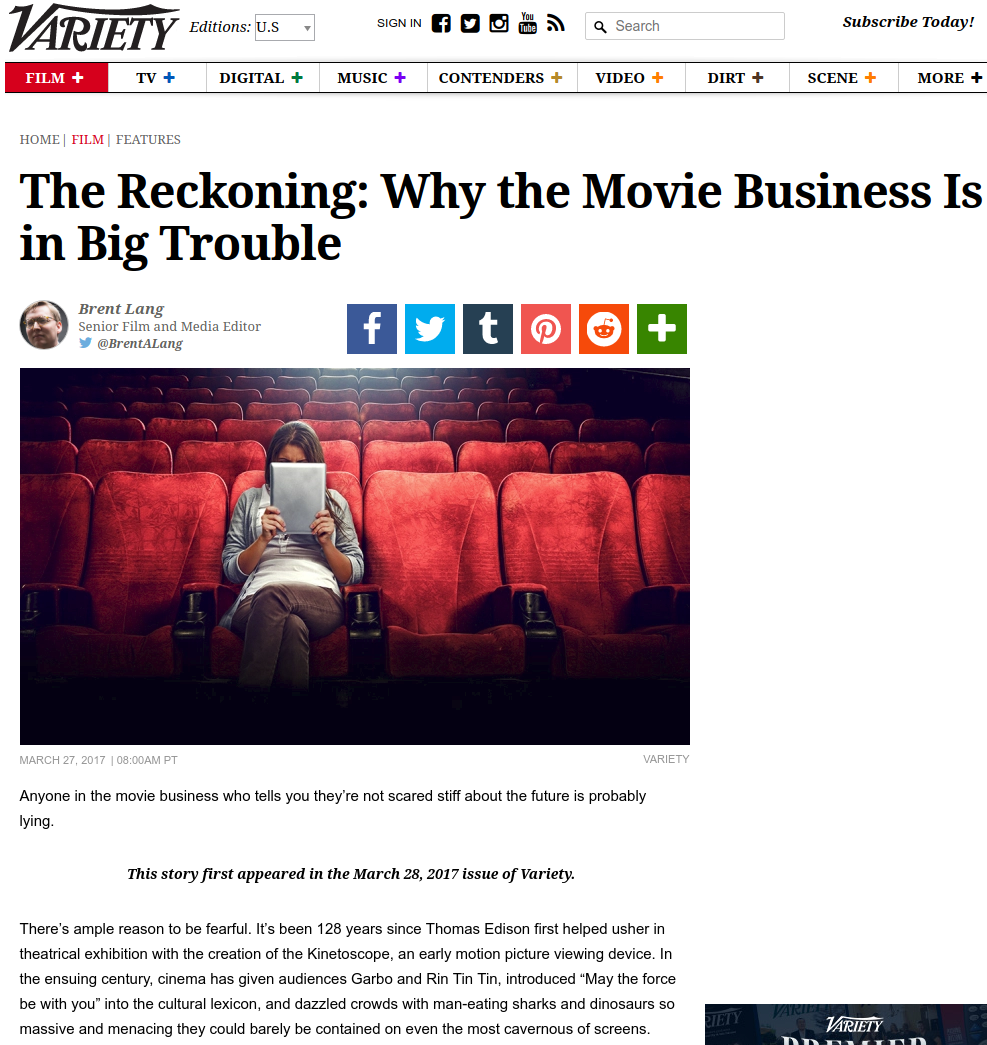
Why the movie business is in trouble

Газета


(Link to the article on Variety's site, with all charts and graphics. Link to PDF version of article.)

This is a long text, and we suggest that you concentrate mostly on the first half of the article, before the author gets into details about the negotiations with specific companies and studios. The last couple of paragraphs are also important.

Here are some questions for discussion:
  1. Overall, what does this article seek to provide the reader?
  2. How does the author organize his analysis? What are the major elements, and how does he arrange them?
  3. What are the two major challenges facing the film industry?
  4. Who are the two “sides” mentioned on page two, second column (“At the very least the two sides are talking.”) Why are their interests supposedly in conflict?
  5. Do you have personal experiences or observations concerning this analysis?
  6. What argument or insight will you remember from this article after you have forgotten the details?
  7. Who is the author’s intended audience?
Which of these words and expressions are new to you?

scared stiff
to usher in
to dazzle
cavernous
to scramble (intrans.)
existential dread
exhibitor
to release
debut
to come to pass
shakeup
windfall
to pull it off
antiquated
to choreograph
“cover my ass”
Zeitgeist
underpinnings
smart money
to be put off
to dry up
slate financing
player
virtual reality
box office
mogul
sprawling
tax credit

to greenlight
bottom line
grand bargain
to fade
to prop up
to condition
impulse buy
to tinker (with)
to kibosh
to wade (into)
on demand, on-demand
exhibition chain
stiff spine
to interface (with)
screen count
to hit
to cannibalize
thorny
myriad
to grandfather
to invite to the table
to differentiate
gargantuan
to reboot
dicey
diminishing returns
tentpole
to snap up


Wednesday, April 26, 2017

Sarah Robb O'Hagan: "I Learned to Win By Failing" (with test link)

Газета 401: Зачёт; 401V, 501V

(Link to full article and accompanying video. Link to PDF document.)

Group 401: This is the text for our online test.

Some of these words and phrases may be on the test....

extreme
to breathe new life into
to bring to light
to be vulnerable
edge, at the edge
to suck
the lead part
to push, to keep pushing
grit (noun)
yeah, so
to get going
pear-shaped, to go pear-shaped
over one's skis
to do one's own thing
learning (noun)
to crush it
to be (stay) in front of
on me (it's on me)
grind (noun)
to trigger
to screw up (trans. and intrans.)
wrong turn
to hone
to be well rounded

Tuesday, April 25, 2017

Good Grief for educators, part two

Warmest thanks to our colleagues for your great stories and dialogues, excellent questions, and helpful comments on the survey form. Here's a slide show based on the vocabulary presentation we gave at our last session:

Wednesday, April 19, 2017

Roll Over Beethoven

Газета

(Click here for original article with links to music. Download PDF version.)

For discussion:
  1. Summarize this article—how does it go beyond a simple obituary?
  2. How did the author organize his material? How does he develop his theme(s)?
  3. For what audience is he writing?
  4. What will you remember about this article after you have forgotten the details?
  5. What should the author have included or left out?
Words and phrases:
opener
daunting
lede
iconic, iconically
scorched earth
to lay out the stakes
on deadline
to break through
to harness
unruly
mission statement
auteur
ennui
to double as
to reverberate
radio play (noun)
to fill in the blanks
folksy
to nag
precious few
tectonic shift
side
shuffle
currency
sensibility
to dispense with
to cover
riff
lucrative
ubiquitous
to relegate, be relegated
oldies
star was receding
dash (noun)

Tuesday, April 18, 2017

Tiny family-run newspaper wins American journalism's most important award

Газета

(Link to full article on Guardian site. Link to PDF file.)

Discussion:
  1. Summarize this article in one or two sentences.
  2. How is the article organized? (What elements of “story” do you see in this article?)
  3. What will you remember from this article after you have forgotten the details?
  4. What do you wish the writer had included or left out?
  5. Who is the intended audience?
  6. What is the role of journalism prizes such as the Pulitzer Prize?
Useful words and phrases:
to take on
to challenge assumptions
to hang out
fueled by
hard-hitting
crash (noun)
to pander
dogged (dogged coverage)
to covet, coveted
to draw
to disclose, undisclosed
gut (in his gut)
to vindicate, to feel vindicated

Monday, April 17, 2017

Good Grief for educators, part one

(Link to the excerpts in PDF format: part one, part two.)

Words and phrases drawn from today's workshop:


Judy compiled some of the errors from last week's homework and summarized them using this slideshow:


Finally, we watched this brief BBC Trending feature: Learn Jane Austen, 'thug' style.

Monday, April 10, 2017

Teaching respectful terms for others

This workshop was based on my article for the Institute's conference in 2013.


The Michele Berdy article mentioned in the presentation is posted here.

Some of the interesting words, phrases, and metaphors used in today's presentation:

to lose faith
bling (or bling-bling)
to make allowances (for)
to hunt down
to give offense
to make allowances
to stop to wonder
marginal, to marginalize
teachable moment
antidote
progressive
out of date
it’s up to us
faintly odd
to prescribe
patch (noun)
to rewrite around
ever-popular
laughable
fastidious, fastidiousness
facility
not to mention

Thursday, April 6, 2017

Newspapers: More on the shifting fortunes of publishing

Газета

(Link to full text and podcast version of original program.)

  1. What type of article is this? How was it “published”? How does this affect the voice and register of the text?
  2. What is the main theme or argument of this text?
  3. What is the point made in the first paragraph by Brooke Gladstone and the following two paragraphs?
  4. What factor often determines a successful publishing season, according to Carolyn Kellogg?
  5. What contributes to the success of audio books? What does Kellogg mean by “crossover point”?
  6. Why should we ask Margaret Atwood where her books belong? (What point is Kellogg making here?)

Words and phrases:

imperiled
something of a …
marked (as in “marked growth”)
to drive (sales, etc.)
to do in
to wheeze
ergo
dog-eared
not so fast
to air
to overturn
to level off
boost (noun)
demographics
to come out of nowhere
tier
to tout
Zen
to ding
tween
vinyl record
to hit a groove
installment
profuse, profusely
crossover
to ramp up (transitive and intransitive)
imprint
make a (big) push for
to come on strong
to get (something) noticed
margin(s)
slipstream
finalist

Tuesday, April 4, 2017

Newspapers: Remembering Yevtushenko

Газета 401, 401В, 501В

(Link to full article.)

For questions relating to the obituary of a famous person, take a look back at this article.

We will also look at this article: "Five reasons why Yevtushenko deserved a Nobel prize."

Words and phrases from the Associated Press article:

to acclaim, acclaimed
to denounce
to pass away
to undergo
to snowball
to gain notoriety
unflinching
to pack, packed (audiences)
rangy
chiseled
declaratory/declamatory
compelling
bespectacled
to rise to prominence
showpiece (noun and adjective)
perennial, perennially
to feature
pronounced (adjective)

Other obituaries include:

The New York Times:
www.nytimes.com/2017/04/01/world/europe/yevgeny-yevtushenko-dead-dissident-soviet-poet.html

The Guardian:
www.theguardian.com/books/2017/apr/02/yevgeny-yevtushenko-obituary

Monday, April 3, 2017

Let's get down to work (don't worry, it will work out)

We began today's class with this presentation:


More work with phrasal verbs, and reviewing the words and phrases from previous classes:

1. For each blank, choose a word from the list below. Some of the words are completions of phrasal verbs based on the verb work. Some words in the list might be used more than once; some might need to be changed to the correct tense:

“Detective Jose Chang here,” I heard myself say. It was my first day at work. I didn’t even have a contract yet. The sergeant had only said that “we’d work ____ the details later.” Like whether I’d be paid overtime or not… But it was a job, and I was happy to have it. I needed the ____, such as health insurance.

The interview had been tough. They had really worked me ____, especially on why I had been out of a job for six months. I had worked ____ a list of reasons for it, but at the end, I just tried to ____ it all over by mentioning that I needed time with my family. Except I hadn’t spoken to my family in five years. In our family, we all have a lot to work ____.

I hadn’t mentioned that I had been trying to work ____ my anxieties with booze. And then stopped. So, yes, I had tried to ____ the issue. It worked.

I do hope this job will work ____. What will I do if it doesn’t? I had ____ it badly in the homicide division in Chicago. It wasn’t just my own case I had destroyed; my mistake had nearly thrown a wrench ____ the works. I had really messed up. Even Mrs. Babsen, my sweet elderly neighbor with six cats, had told me I had ____ it all on myself.

I hoped moving home to Tucson would ____ my career, which it needed, badly. At least in Tucson they wouldn’t ask me about my name. Everyone would assume my father’s family came to work on the railroads, and my mother’s when the river still had water in it all year and the country was named New Spain.

You just knew I would work ____ that last bit, about how the U.S. stole a third of Mexico’s territory in the Mexican-American War, didn’t you? I can get really worked ____, thinking about it still.

over   bring   gloss   up   benefits   out   blow  into   in  through  evade   jump-start

2. Homework:

Please create a dialogue using 10 of the words/phrases in the list below or the phrasal verbs in the exercise above.

larger trends at work
eye-rolling
punch line
over the top
To pull any/your punches
to overstate the case
bent [entrepreneurial bent]
to channel
to streamline
paywall
job security
word of mouth
the more the merrier
to jump-start
to make [the, a] case for
what they wanted out of life
to be struck by
to pull clear (of)
to settle (an argument, a question)
setting themselves up (for)
to face the risks
special interest groups
to plug in
dead-end job
to end up

(You can download a PDF version of these exercises from here.)

Friday, March 31, 2017

"Walking the Dog"

In class, we heard Hans Theessink performing his virtuoso version of the song, starting at about 1 minute, 10 seconds:


This classic was originally written and recorded by Rufus Thomas. In this great video from 1988, we see him performing with legendary musicians Steve Cropper (guitar), Matt "Guitar" Murphy, and Donald "Duck" Dunn (bass guitar):


Many other great musicians have recorded this song, including the Rolling Stones:


Here's how the original audience heard Rufus sing it in 1963:

Here are the words to that original song:

Mary Mack dressed in black
Silver buttons all down her back
Hello tipsy toes
She broke the needle and she can't sew

Walking the dog
Just a walking the dog
If you don't know how to do it
I'll show you how to walk the dog
Come on now, come on, come on

I asked her mama for fifteen cents
To see the elephant jump over the fence
He jumped so high, he touched the sky
Never got back till the fourth of July

Walking the dog
Just a walking the dog
If you don't know how to do it
I'll show you how to walk the dog
Come on now, come on, come on

Mary, Mary, quite contrary
Tell me, how does your garden grow?
You got silver bells and you got cockleshells
Pretty maids all in a row

Walking the dog
Just a walking the dog
If you don't know how to do it
Show you how to walk the dog
Come on now, come on, come on
Oh oh, just a just just a walking
just a just a just a walking
oh, yeah, if you don't know how to do it
I'll show you how to walk the dog ... oh ...